Retreating Blade Stall: Why Helicopters Have a Never-Exceed Speed
FAA Ref: FAA-S-ACS-15 Area I Task F (Performance and Limitations)
Scenario & Physics Summary
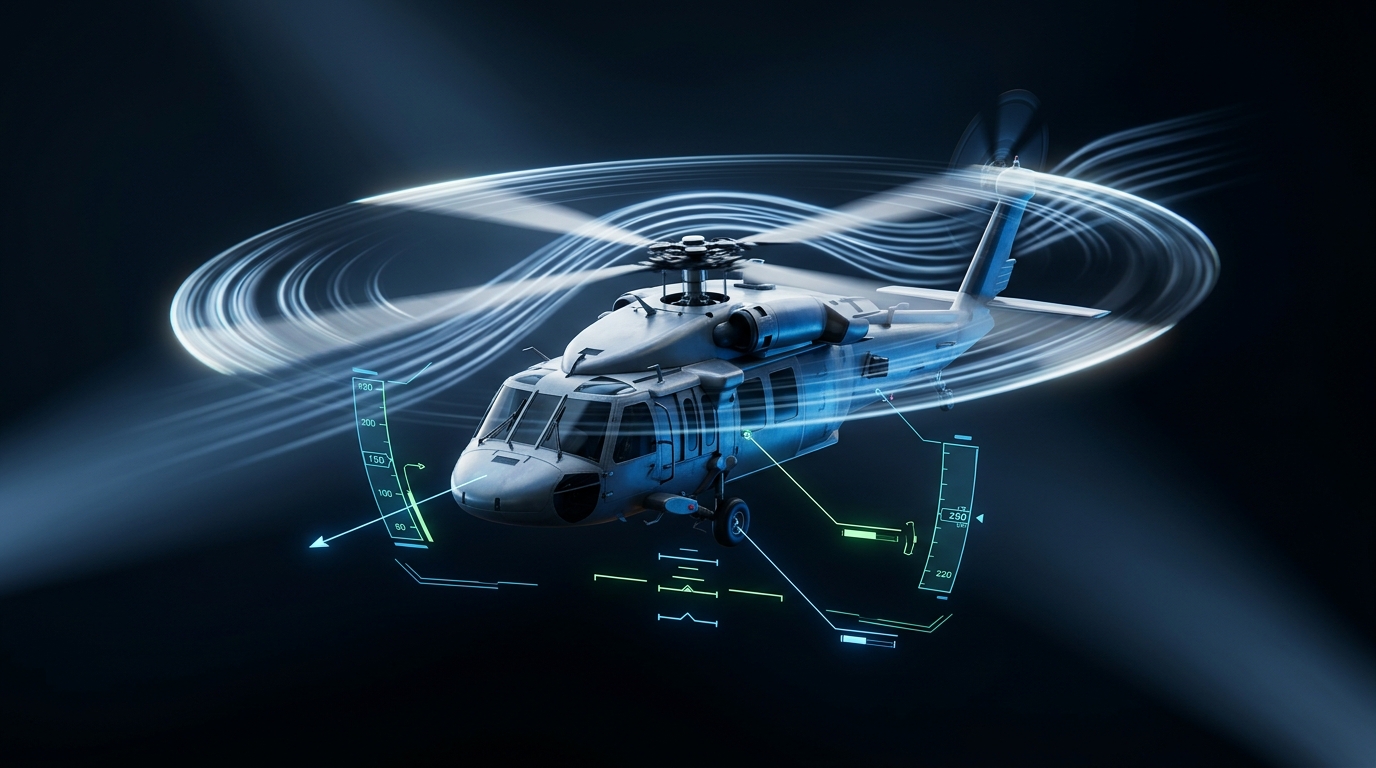
In forward flight the retreating blade sees low airspeed and a high angle of attack, and at some forward speed it stalls. It limits never-exceed speed and is felt as low-frequency vibration, nose pitch-up and a roll toward the retreating blade (Helicopter Flying Handbook).
Interactive 3D Visual Plates & Scenario Media
Plate 1: Retreating Blade Stall: Why Helicopters Have a Never-Exceed Speed
Plate 2: Retreating Blade Stall: Why Helicopters Have a Never-Exceed Speed
Plate 3: Retreating Blade Stall: Why Helicopters Have a Never-Exceed Speed
Plate 4: Retreating Blade Stall: Why Helicopters Have a Never-Exceed Speed
Aerodynamic & Operational Physics
The relative airflow is higher on the advancing side and lower on the retreating side. To keep lift equal, the advancing blade flaps up (angle of attack decreases) and the retreating blade flaps down (angle of attack increases).
As forward speed increases, the low blade speed and high angle of attack on the retreating blade eventually cause a stall and loss of lift.
High weight, low rotor rpm, high density altitude, turbulence and steep, abrupt turns all make it more likely, and it occurs at a lower forward airspeed at altitude, so VNE decreases with altitude.
Recovery: the first step is usually to reduce collective. Moving the cyclic aft or forward worsens the stall.
FAA Exam Gotcha Alert
Exam Trap: Do not recover with the cyclic. Aft cyclic produces a flare effect that increases angle of attack, and forward cyclic also deepens the stall because it increases the retreating blade angle of attack.
Frequently Asked Questions & Exam Explanations
How is retreating blade stall recognized?
By a low frequency vibration, pitching up of the nose and a roll in the direction of the retreating blade.
Why does VNE decrease with altitude?
At altitude higher blade angles are required to maintain lift at a given airspeed, so retreating blade stall is encountered at a lower forward airspeed. Manufacturers publish charts showing VNE decreasing with altitude.
Master Retreating Blade Stall: Why Helicopters Have a Never-Exceed Speed in the Simulator
Drill targeted FAA knowledge test questions with step-by-step mathematical decoders and regulatory clause links.