 Aero Academic
Under 14 CFR 107.41, you may not fly a small unmanned aircraft in Class B, Class C or Class D airspace, or within the surface area of Class E airspace designated for an airport, without prior authorization from Air Traffic Control. Class G needs no authorization, but other rules still apply: do not interfere with airport traffic, respect restricted areas and obey temporary flight restrictions.
Checked against: 14 CFR Part 107 (current eCFR text), sections 107.29, 107.41 to 107.49; FAA-S-ACS-10B, Area of Operation II (Airspace Classification and Operating Requirements).
| Airspace | Requirement under Part 107 | Source |
|---|---|---|
| Class B, C or D controlled airspace | Prior authorization from ATC | 14 CFR 107.41 |
| Surface area of Class E airspace designated for an airport | Prior authorization from ATC | 14 CFR 107.41 |
| Other Class E airspace and Class G | No ATC authorization under 107.41; all other Part 107 rules still apply | 14 CFR 107.41 and Subpart B |
| Any airport, heliport or seaplane base environment | Do not operate in a manner that interferes with operations and traffic patterns | 14 CFR 107.43 |
| Prohibited or restricted areas | Permission from the using or controlling agency | 14 CFR 107.45 |
| Areas under a flight restriction notice (for example a TFR) | Comply with 14 CFR 91.137 through 91.145 and 99.7 | 14 CFR 107.47 |
| Code | What the applicant must understand |
|---|---|
| UA.II.A.K1 | General airspace: Class B, C, D, E and G |
| UA.II.A.K2 | Special use airspace: prohibited, restricted, warning areas, military operations areas, alert areas, controlled firing areas |
| UA.II.A.K3 | Other airspace areas: Airport Advisory Services, Military Training Routes, TFRs, parachute jump operations, TRSAs, National Security Areas, VFR routes |
| UA.II.A.K4 | Air Traffic Control and the National Airspace System |
| UA.II.B.K1 to K3 | Basic weather minimums, ATC authorizations and limits, operations near airports |
| UA.II.B.K4 | Potential flight hazards such as balloons, lasers, thermal plumes and the wire environment |
| UA.II.B.K5 to K10 | NOTAM system, night equipment, ground structures and lighting, manned aircraft lighting, sUAS lighting |
Section 107.41 says that no person may operate a small unmanned aircraft in Class B, Class C or Class D airspace, or within the lateral boundaries of the surface area of Class E airspace designated for an airport, unless that person has prior authorization from ATC. The word prior matters: you obtain the authorization before you launch, not after you notice you are near an airport.
The rule is about the airspace, not about how high you fly. A short, low flight inside the airspace described in 107.41 still needs authorization. Table 1 shows how the rule sits among the other airspace requirements in Subpart B.
On the knowledge test, expect questions that give you a chart excerpt or a description of the location and ask whether authorization is needed. The method is the same each time: identify the class, check whether it is B, C, D or an airport surface-area Class E, and apply 107.41.
The Remote Pilot ACS lists general airspace under UA.II.A.K1: Class B, Class C, Class D, Class E and Class G. Class B, C and D are controlled airspace around airports, and each has its own shape and ATC requirements. Class E is controlled airspace that begins at various heights, and some Class E areas extend to the surface at an airport. Class G is uncontrolled airspace.
You must also understand special use airspace under UA.II.A.K2, such as prohibited, restricted and warning areas, military operations areas, alert areas and controlled firing areas, and other airspace areas under UA.II.A.K3 such as military training routes, temporary flight restrictions and national security areas. The ACS references include 14 CFR part 71, advisory circular 107-2, the Aeronautical Information Manual and the Pilot’s Handbook of Aeronautical Knowledge.
Section 107.43 prohibits operating a small unmanned aircraft in a manner that interferes with operations and traffic patterns at any airport, heliport or seaplane base. This applies even in Class G airspace and even at a small airport with no tower. If an aircraft is in the traffic pattern, you yield and land or move away.
Practical advice: before you fly near any airport, check the airspace on a current chart, check whether the airport has a tower, and listen for traffic if you have a radio. When in doubt about the class or boundary, treat the area as controlled and seek authorization. The cost of asking is small compared with the cost of an unauthorized flight.
Section 107.45 says you may not operate in prohibited or restricted areas unless you have permission from the using or controlling agency. Prohibited areas are the stricter of the two, and you should assume you cannot fly there. Restricted areas are active at certain times, and the controlling agency can tell you when.
Section 107.47 requires the remote pilot in command to comply with 14 CFR 91.137 through 91.145 and 99.7. Those sections cover temporary flight restrictions in disaster and hazard areas, in the vicinity of certain events and in other special cases, and special security instructions. The NOTAM system is how these are published, and UA.II.B.K5 asks you to know how to obtain an established NOTAM through Flight Service.
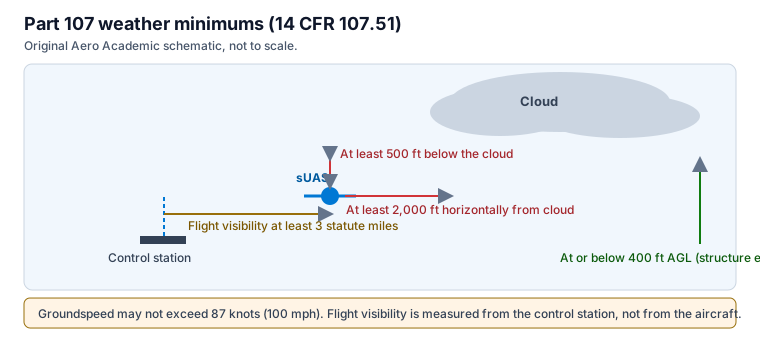
Part 107 also applies limits that hold in all airspace. Section 107.51 sets a maximum groundspeed of 87 knots, a maximum altitude of 400 feet above ground level except within a 400 foot radius of a structure, a minimum flight visibility of 3 statute miles from the control station, and cloud clearance of 500 feet below and 2,000 feet horizontally. Figure 1 summarizes them.
Our companion guide on Part 107 weather and operating limits goes through these limits and the weather sources in detail. For airspace questions, remember that authorization changes where you may fly, while 107.51 limits how you fly once you are there.
Section 107.29 covers operations at night and during civil twilight. For night operations the remote pilot must have completed the initial knowledge test or training under 107.65 after April 6, 2021, and the aircraft must have lighted anti-collision lighting visible for at least 3 statute miles with a flash rate sufficient to avoid a collision. During civil twilight, which begins 30 minutes before official sunrise and ends at official sunrise, and begins at official sunset and ends 30 minutes after, the same lighting is needed.
The remote pilot may reduce the intensity of the lighting but may not extinguish it if conditions make that safer. The ACS lists manned aircraft lighting and sUAS lighting requirements as knowledge elements, so be able to explain both.
Section 107.49 requires the remote pilot in command to assess the operating environment before flight, considering local weather conditions, local airspace and any flight restrictions, the location of persons and property on the surface, and other ground hazards. Use that list as your airspace checklist.
In practice that means you identify the airspace class where you plan to fly, check for TFRs and NOTAMs, check the proximity of airports and heliports, confirm you have any authorization you need, and note the weather minimums. Then brief any visual observer and anyone directly participating, and keep records of what you checked.
You want to fly over a farm that sits a mile from a small airport. First, check the chart: is the airport inside Class D airspace or the surface area of a Class E designated for it? If it is, 107.41 applies and you need prior authorization from ATC before you launch, however low you intend to fly.
If the airport is in Class G airspace, you do not need authorization, but 107.43 still applies. Check whether aircraft are using the traffic pattern, plan to stay well clear, and be ready to land immediately if one approaches. Then check for TFRs and NOTAMs for that date.
The most common error is assuming that a low altitude removes the authorization requirement. It does not: 107.41 is about the airspace. A second is assuming that Class G means no rules, when 107.43 and the operating limits still apply. A third is forgetting that Class E has two faces: most Class E needs no authorization, but the surface area designated for an airport does. A fourth is relying on an old chart or a map app without checking the current NOTAMs and TFRs.
Section 107.41 does not require ATC authorization in Class G. The other Part 107 rules still apply, including the operating limits in 107.51 and the prohibition on interfering with airport traffic in 107.43.
Class B, Class C, Class D, and the lateral boundaries of the surface area of Class E airspace designated for an airport (14 CFR 107.41).
Only with permission from the using or controlling agency (14 CFR 107.45). Prohibited areas should be treated as closed.
Temporary flight restrictions are published by notice to airmen. Section 107.47 requires compliance with 14 CFR 91.137 through 91.145 and 99.7, and the ACS expects you to know how to obtain a NOTAM through Flight Service.
Lighted anti-collision lighting visible for at least 3 statute miles with a flash rate sufficient to avoid a collision, and the remote pilot must have completed the initial knowledge test or training after April 6, 2021 (14 CFR 107.29).
https://www.aeroacademic.com/guides/us-part-107-airspace-for-remote-pilots